} 大学院生 Archives - Page 27 of 27 - 東京大学ファカルティ・ディベロップメント | 東大FD | TODAI FD.COM | 東京大学
Categories
Event

【UTokyo Global FD Research Seminar】

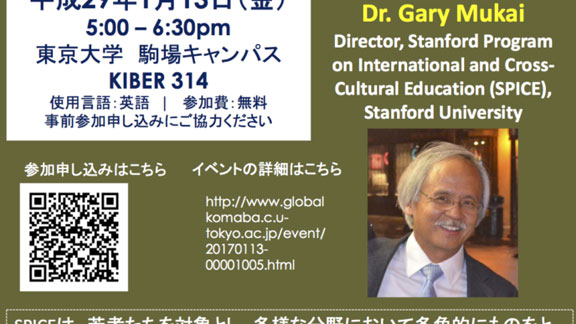
As part of our Global FD initiative at UTokyo, we are hosting Dr. Gary Mukai, who is the Director of the Stanford Program on International and Cross-Cultural Education (SPICE) at Stanford University. He has a long and distinguished career in teaching East-Asia related issues to secondary school students, and his experience will be of great help to us in considering how we might teach about Japan to international students who may have had limited experience with Japanese language, culture, and society here at Komaba. Dr. Mukai will be giving two talks, one on January 10th, 2017 and the other on January 13th, 2017. Please find below details of the two talks. *[SEMINAR 1] Divided Memories: Comparing History Textbooks* We study history, many say, to learn from history’s mistakes. But what happens when our interpretations of history differ? The “Divided Memories” project was begun at Stanford University in 2007 to compare prevalent history textbooks from five Pacific Rim societies: China, Japan, South Korea, Taiwan, and the United States. How do these textbooks treat sensitive episodes in world history? Do they present similar or dissimilar interpretations of history? Scholars examined 20 different textbooks in an effort to address these questions. This session introduces SPICE-devised teaching strategies from the “Divided Memories” project that help to make academic scholarship accessible to students. Date: Tuesday, January 10, 2017 5:00-6:30pm Place: University of Tokyo, Komaba Campus, KIBER 314 Eligibility: Anyone interested Capacity: 50 Admission: Free Language: English Pre-registration is encouraged, but we also welcome drop-ins! Please register here: https://www.globalkomaba.c.u-tokyo.ac.jp/cypochi/form/ pc/gkomaba000171.html Event URL: http://www.globalkomaba.c.u-tokyo.ac.jp/en/event/201701 10-00001001.html *[SEMINAR 2] Engaging Students from Japan and the United States in Distance-Learning Courses* As a way to encourage high school students in the United States to pursue Japanese studies at the collegiate level, SPICE launched (14 years ago) the Reischauer Scholars Program (RSP), an online course for high school students in the United States that focuses on Japanese society and culture and U.S.–Japan relations. Three years ago, SPICE launched a parallel course for high school students in Japan called Stanford e-Japan, which focuses on U.S. society and culture and U.S.–Japan relations. This session introduces interactive teaching strategies utilized in the courses, including those that engage students in the RSP and Stanford e-Japan with one another. Date: Friday, January 13, 2017 5:00-6:30pm Place: University of Tokyo, Komaba Campus, KIBER 314 Eligibility: Anyone interested Capacity: 50 Admission: Free Language: English Pre-registration is encouraged, but we also welcome drop-ins! Please register here: https://www.globalkomaba.c.u-tokyo.ac.jp/cypochi/form/ pc/gkomaba000172.html Event URL: http://www.globalkomaba.c.u-tokyo.ac.jp/en/event/201701 13-00001002.html Inquires: Shoko Sasayama, Ph.D gfd-tokyo@adm.c.u-tokyo.ac.jp We warmly welcome any interested individuals to come to these talks. It would be much appreciated if you could publicize to others who may be interested. Thank you in advance for your kind cooperation, and we hope to see many of you there! Sincerely, Global FD committee Email: gfd-tokyo@adm.c.u-tokyo.ac.jp
Categories
Information

[Deadline Advanced] “Beyond Interactive Teaching”

We have received more applications than expected for the event Big Real Session: Beyond Interactive Teaching” to be held on February 4th, 2017. Thank you very much for your interest in our event.

Therefore, we would like to advance the application deadline (set initially on Friday, January 20th) to Friday, December 28th.
For those who would like to join the event, please apply from the <Application Form> before 09:00 AM on Friday, December 28th.
As stated earlier, we will select the participants by lottery in case the number of applicants surpasses the limit.
We will notify you of the result of the selection on Wednesday, January 5th at the e-mail address you entered on the application form.
We are sorry for those who applied for the event at an earlier date, but we sincerely appreciate your patience since the schedule includes the new-year holidays.
Categories
Event

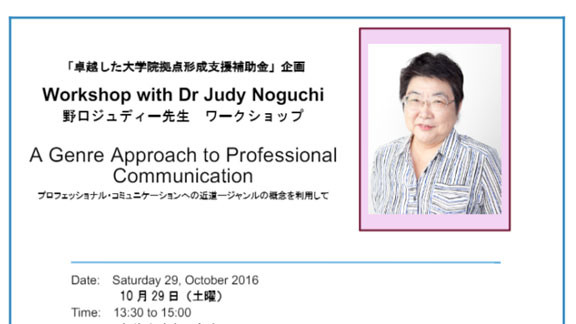
【FD Workshop】A Genre Approach to Professional Communication

Date: Saturday 29, October 2016
Time: 13:30 to 15:00
Place: Room 201 Building 10 2F
The University of Tokyo, Komaba I Campus

*The workshop is conducted in English.

A Genre Approach to Professional Communication

A “professional” is someone who possesses and uses the skills with which to communicate with members of his or her target discourse community. Acquiring these skills often requires concerted effort, even for native speakers of the target language. In the case of nonnative speakers of that language, the task can sometimes be a very challenging one. What can be helpful is a genre-approach to mastering what is necessary for effective communication. “Genre” as it is used here refers to the type of target communication event, for example, a research article, a policy paper, an oral presentation of a research project. Genres for professional communication have evolved to promote efficient exchange of ideas among members of a discourse community and therefore need to be mastered in order to gain a voice in that community. This workshop will start with an introduction to the concepts of English for specific purposes, including its basis in systemic functional linguistics and the concept of “discourse community.” This will be followed by the OCHA process and PAIL product-oriented approach to the research article, using move analysis and identifying hint expressions that guide the reader through the text. Ideas on how to use corpus linguistics tools will also be introduced to support the writing process. Although writing will be the main focus, the concepts to be covered can aid efficient reading and even informed editing and reviewing of manuscripts.

Dr Judy Noguchi is Dean and Professor in the Faculty of Global Communication at Kobe Gakuin University.

This workshop is for University of Tokyo graduate students who are interested in science writing or teaching of science writing. To attend the workshop, please e-mail Akiko Katayama at <akatayama @ g.ecc.u-tokyo.ac.jp> by Oct. 26.
Categories
Information

[Report] Workshops on the Application Documents for the JSPS Fellowships AY2015

Summary

We held workshops on the application documents for the JSPS fellowships on March 20th, 23rd, and April 28th, 2015.
Here we call those who create application documents “applicants,” and those who support them “mentors.”
Mentors checked one or two application documents before the workshop.
The workshop proceeded in the following order: mentor meeting (mentors), briefing (plenary), mentoring (plenary), creation of the application document (applicants), and mentor meeting (mentors).

Workshop Timeline

12:00–13:00 Mentor Meeting (Mentors)
Mentors brought their lunch and shared with each other the improvement points of the pre-checked application documents.
They organized the points so that they could give feedback in the plenary briefing session.
Specifically, they pointed out things such as “Many documents were unbalanced,” (e.g., “The background of the research occupies half the document.”) and “The section title and the text were not aligned,” (e.g., “Research goal includes a description of methods, which is unnecessary for the section.”).

13:00–13:30 Orientation (Plenary)
We explained the summary and schedule of the workshop, followed by a self-introduction among the participants and feedback.

13:30–15:30 Mentoring (Plenary)
The applicants had a one-hour one-on-one meeting (i.e., mentoring) with the mentors on how to improve their application documents.

15:30–18:00 Creation of the Application Document (Applicants) and Mentor Meeting (Mentors)
Following the mentoring session, applicants refined their application documents based on the feedback they had received. Mentors shared what the mentoring session was like with each other at the mentor meeting.
Finally, participants shared their thoughts on the workshop.

Reflection on the Workshop

It was great that the mentors took their time to read the application documents in advance and were able to encourage the applicants to improve their documents through careful mentoring.
However, reading the document thoroughly beforehand and joining the workshop earlier than the applicants mean that it was quite a burden for the mentors. The workshop has room for improvement in that sense.
Also, we offered a session for creating the documents after mentoring, but there was not so much interaction between the applicants and mentors during the session, so it might not be necessary to incorporate such an activity into the workshop itself.

Afterword

Many applicants seemed to be satisfied with the workshop, although there is still much more to improve the event.
Mentors, too, seemed to be satisfied to share tips on how to create the application documents at the mentor meeting.
Therefore, the event was overall a success.
We would like to improve and conduct better workshops in the future based on the reflection.

(Appendix) Background of the Workshop

It is not too much to say that the research fellowship awarded by the Japan Society for the Promotion of Science (JSPS) is an important title to obtain for becoming a researcher. In fact, 80.5% of those who became research fellows entered the “full-time researcher post” according to the survey on the people five years after they had been awarded the fellowship (JSPS 2015).
Those who have prepared an application document for the research fellowship even once must have experienced how their research theme and plan became sophisticated through the process.
In that sense, I believe that the process of creating the application document itself has value, apart from becoming a research fellow.

It may be important to create the document struggling alone, but I strongly believe that sharing the wisdom in creating the document helps everyone enhance not only the quality of the document but also the quality of the research, and that is why I planned and conducted this workshop.

[Reference]
Japan Society for the Promotion of Science (2015) Tokubetsukenkyūin – DC no shūshokujōkyōchōsakekka ni tsuite [Survey result of employment opportunities for research fellows (DC)] Retrieved April 3, 2017, from https://www.jsps.go.jp/j-pd/data/pd_syusyoku/27_dcgaiyou.pdf

(Lui Yoshida,  Alumnus of the 1st UTokyo FFP)

Categories
Information

[Report] Workshops on the Application Documents for the JSPS Fellowships AY2016

Summary

We held workshops on the application documents for the JSPS fellowships on March 28th, April 10th, and 23rd, 2016.
Here we call those who create application documents “applicants,” and those who support them “mentors.”
Building on the reflection on the workshops held in AY2015, we removed the mentor meeting session to ease the burden on mentors and asked them to check one or two application documents in advance if possible.
Also, to enhance the quality of the application documents before the workshop, we provided the applicants with checksheets that gave tips on creating the documents and worksheets that helped them structure the application information and asked them to get prepared for the workshop by filling in the sheets.
The workshop proceeded in the following order: briefing, peer review, review of the application documents, mentoring, and reflection.

Teams and Groups

We made teams of one mentor and one or two applicants.
We also made groups that consist of two teams.
The peer review, described later, was conducted in groups while mentoring was conducted in teams.

Workshop Timeline

13:00–13:30 Briefing
We explained the summary and schedule of the workshop, followed by a self-introduction among the participants and comments on the tips on creating the application documents.

13:30–14:30 Peer Review
Applicants first explained their documents using the worksheet (5 min), followed by the group discussion on how to improve the documents (9 min).
Groups consisted of four applicants and two mentors in principle, so the above process was repeated four times.
They discussed focusing on the improvement of the structure and logic using the worksheet.

14:30–15:00 Review of the Application Documents
Participants read the application documents before moving on to the mentoring session.
Teams consisted of two applicants and one mentor in principle, so the mentor read the two application documents while the applicants read the other one’s document, then they examined the improvement points.

15:00–17:00 Mentoring
The applicants had a one-hour one-on-one meeting (i.e., mentoring) with the mentors on how to improve their application documents.
The other applicant listened to the mentoring and took notes on their PCs, and gave feedback as necessary.

17:00–17:30 Reflection
Participants reflected on the workshop and shared what they had learned.

Reflection on the Workshop

It was good that we were able to ease the burden on the mentors before the workshop by building on the reflection on the previous workshops.
Also, we were able to conduct the workshop efficiently by redesigning the structure.
However, most activities were carried out in groups/teams, which led to less time for sharing the information with the whole participants. There is room for improvement in that sense.

Afterword

Many applicants seemed to be satisfied with the workshop, although there is still much more to improve the event.
Mentors, too, seemed to be satisfied to share tips on how to create the application documents.
Therefore, the event was overall a success.
We would like to improve and conduct better workshops in the future based on the reflection.

(Appendix) Background of the Workshop

It is not too much to say that the research fellowship awarded by the Japan Society for the Promotion of Science (JSPS) is an important title to obtain for becoming a researcher. In fact, 80.5% of those who became research fellows entered the “full-time researcher post” according to the survey on the people five years after they had been awarded the fellowship (JSPS 2015).
Those who have prepared an application document for the research fellowship even once must have experienced how their research theme and plan became sophisticated through the process.
In that sense, I believe that the process of creating the application document itself has value, apart from becoming a research fellow.

It may be important to create the document struggling alone, but I strongly believe that sharing the wisdom in creating the document helps everyone enhance not only the quality of the document but also the quality of the research, and that is why I planned and conducted this workshop.

[Reference]
Japan Society for the Promotion of Science (2015) Tokubetsukenkyūin – DC no shūshokujōkyōchōsakekka ni tsuite [Survey result of employment opportunities for research fellows (DC)] Retrieved April 3, 2017, from https://www.jsps.go.jp/j-pd/data/pd_syusyoku/27_dcgaiyou.pdf

(Lui Yoshida,  Alumnus of the 1st UTokyo FFP)

Categories
Information

Free Online Course “Interactive Teaching”

The 4th semester of “Interactive Teaching,” a free online course run by the University of Tokyo, starts on April 27th, 2016.

Please click the following link for details and the application.

Course Summary (The link will direct you to the website of gacco.)

The course has been highly appreciated by graduate students and those who are involved in education and training, but the gacco course will end this semester. Don’t miss the final chance of taking the course!
Voices of the registrants
Outcomes of the course (survey results)

Categories
Information

New Leaflet Available for the UTokyo FFP


The latest leaflet of “The University of Tokyo Future Faculty Program (UTokyo FFP)” is now available. It is a tri-fold A4-sized leaflet that briefly describes the goals and structure of the UTokyo FFP as well as the voices of alumni. We distribute the leaflets to anyone who is interested in the UTokyo FFP.

Please contact us and let us know your address and the number of leaflets you would like from the inquiry form.