} 大学院生 Archives - Page 2 of 27 - 東京大学ファカルティ・ディベロップメント | 東大FD | TODAI FD.COM | 東京大学
Categories
Event

[Oct 23] Rubrics’ Design

The University of Tokyo Faculty Development Open (UTokyo FD Open) is a series of workshops and sessions conducted throughout the semester and entirely in English. These events address key educational topics to promote the development of teaching skills at university level.

(For general information about UTokyo FD Open, please click here.)

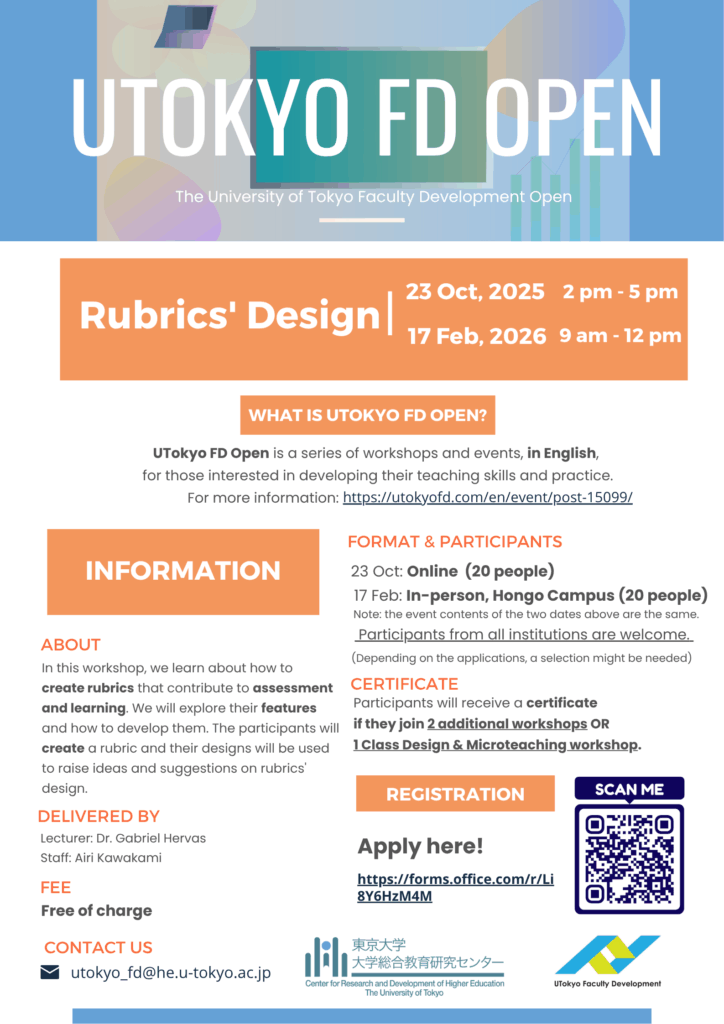
Rubrics’ design (October 23rd, 14:00-17:00)

Apply here or scan the QR code below

About

In this workshop, we learn about how to create rubrics that contribute to assessment and learning. We will explore their features and how to develop them. The participants will create a rubric and their designs will be used to raise ideas and suggestions on rubrics’ design.

Time & Format

October 23rd, 2025, 14:00-17:00
Online (Zoom)

Instructor

Dr. Gabriel Hervas

Participants

20 people
Participants from all institutions are welcome

(Note: Due to the practical nature of the workshop, the number of participants is limited, and a selection process will be conducted if the number of registrations surpasses the available spots.)

Fee 

Free of charge

Certificate

Certificates of completion will be issued if participants complete either (1) Class Design & Microteaching + 1 additional workshop/seminar OR (2) 3 workshops other than Class Design & Microteaching

(Those who would like to receive a certificate must simultaneously register for either the “Class Design & Microteaching” session or any two other sessions from the UTokyo FD Open series.)

Application

Please click here or scan the QR code below.


Poster of the workshop

You can also download the poster in pdf from here.


If you have any questions, please feel free to contact us at utokyo_fd[at]he.u-tokyo.ac.jp (please replace [at] with @).

Categories
Event

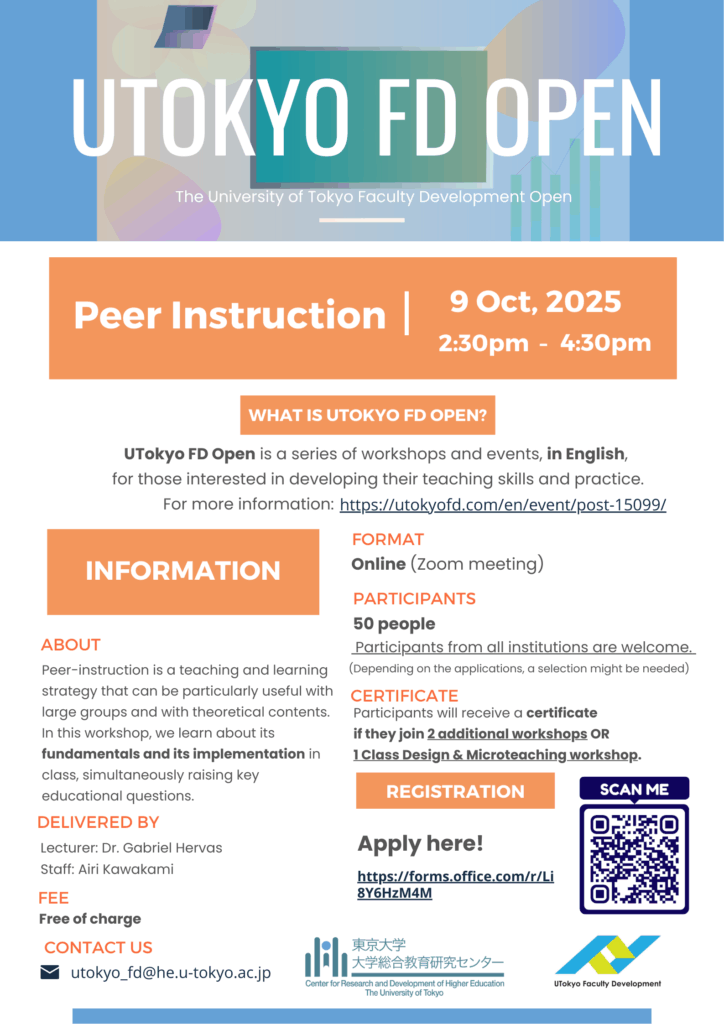
[Oct 9] Peer Instruction

The University of Tokyo Faculty Development Open (UTokyo FD Open) is a series of workshops and sessions conducted throughout the semester and entirely in English. These events address key educational topics to promote the development of teaching skills at university level.

(For general information about UTokyo FD Open, please click here.)

Peer Instruction (October 9th, 14:30-16:30)

Apply here or scan the QR code below

About

Peer-instruction is a teaching and learning strategy that can be particularly useful with large groups and with theoretical contents. In this workshop, we learn about its fundamentals and its implementation in class, raising at the same time key educational questions.

Time & Format

October 9th, 2025, 14:30-16:30
Online (Zoom)

Instructor

Dr. Gabriel Hervas

Participants

50 people
Participants from all institutions are welcome

(Note: Due to the practical nature of the workshop, the number of participants is limited, and a selection process will be conducted if the number of registrations surpasses the available spots.)

Fee 

Free of charge

Certificate

Certificates of completion will be issued if participants complete either (1) Class Design & Microteaching + 1 additional workshop/seminar OR (2) 3 workshops other than Class Design & Microteaching

(Those who would like to receive a certificate must simultaneously register for either the “Class Design & Microteaching” session or any two other sessions from the UTokyo FD Open series.)

Application

Please click here or scan the QR code below.


Poster of the workshop

You can also download the poster in pdf from here.


If you have any questions, please feel free to contact us at utokyo_fd[at]he.u-tokyo.ac.jp (please replace [at] with @).

Categories
Event

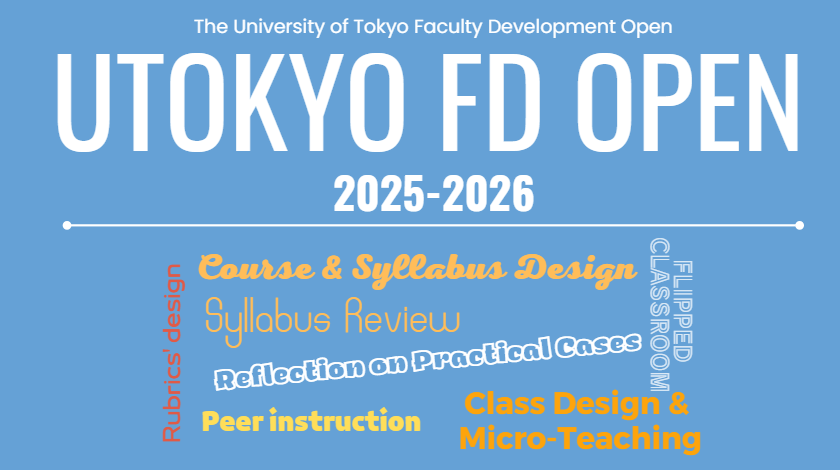
UTokyo FD Open 2025-2026: Information and Application

The University of Tokyo Faculty Development Open (UTokyo FD Open) is a series of workshops and seminars conducted throughout a semester and entirely in English. These events address key educational topics to promote the development of teaching skills at university level.

Apply here or scan the QR code below

Features of UTokyo FD Open

○ Participants will be able to acquire and develop key educational knowledge and skills
○ Participants can create bonds with colleagues from different institutions and disciplines
○ The workshops are open to faculty, researchers and Ph.D. students, regardless of affiliation
○ Certificates of completion will be issued if participants complete either (1) Class Design & Microteaching + 1 additional workshop/seminar OR (2) 3 workshops other than Class Design & Microteaching
○ The workshops emphasize reflection + discussion + practice (RDP)

Note: All workshops/seminars will be conducted fully in English. Participants are required to actively engage in discussions and activities in English throughout the sessions.

UTokyo FD Open 2025-2026

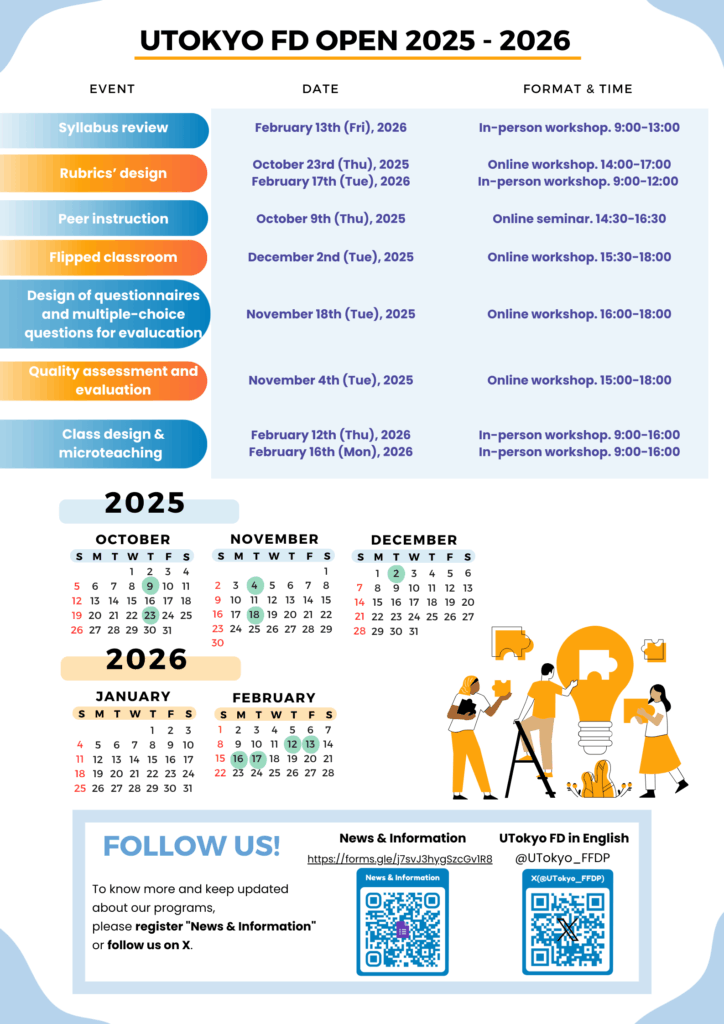
UTokyo FD Open will offer 9 events (in different format and at different locations) addressing topics related with syllabus design, class design and microteaching, rubrics’ design, flipped classroom, and peer-instruction. The details about each event are included in the following image, and also in the application form and the leaflet of UTokyo FD Open.

We are open to organizing new events based on your interests, so please reach out to us with them at utokyo_fd[at]he.u-tokyo.ac.jp (please replace [at] with @).

Application (for all workshops and sessions)

Please click here or scan the QR code below.

The participants say…

“The teacher/facilitator has superb skills in navigating the workshop. He had been so keen in picking up the reactions of the participants, controlled/managed the workshop but also allowed participants to freely delve into deep thoughts and discussions.”

“(The strengths of the workshop were) Interactive and hands-on activities; Experienced facilitator; Relevant and up-to-date content; Clear learning objectives; Accessible and inclusive design.”

Leaflet with the information about each event

Please click here to download the leaflet in pdf.

Next events

Please click here to check the details of the next UTokyo FD Open event.


If you have any questions, please feel free to contact us at utokyo_fd[at]he.u-tokyo.ac.jp (please replace [at] with @).

Categories
Information

Publication of “Interactive Teaching: Jissen-hen 3” Now Available on UTokyo BiblioPlaza

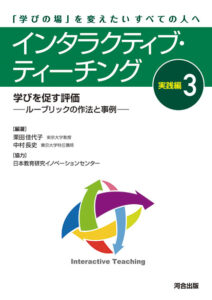
The introduction of the book, “Interactive Teaching: Jissen-hen 3 Manabi o unagasu hyoka [Evaluations to Promote Learning – Rubric Manners and Examples]” (edited by Kayoko Kurita and Nagafumi Nakamura, with the cooperation of Japan Center for Educational Research and Innovation; published by Kawai Publishing) has been published on UTokyo BiblioPlaza, a website that features books authored by faculty members at the University of Tokyo, primarily in the humanities and social sciences.

The concise summary of the book contents is available, so please take a look at the link below.

UTokyo BiblioPlaza – Manabi wo unagasu hyoka

In addition, introductions to other books in the Interactive Teaching series are also available:

Categories
Event

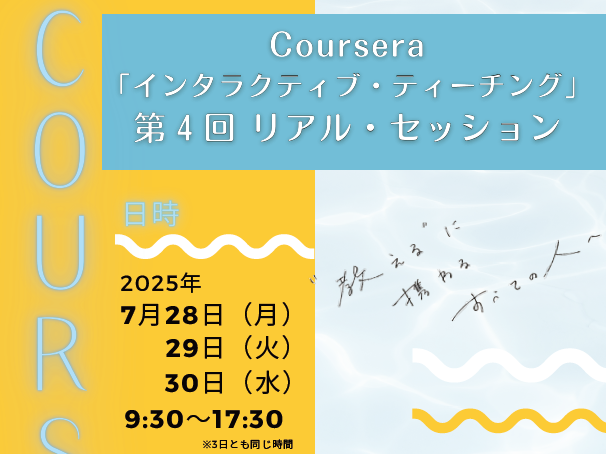
[Jul 28, 29, 30] “Interactive Teaching” Real Session 

We are very pleased to announce that we will hold an intensive 3-day in-person session, Interactive Teaching Real Session. In this session, participants will not only deepen the knowledge they have learned in Interactive Teaching but also learn practically through many works such as conducting a microteaching class, designing a syllabus, and creating a TP/SAP chart. 

If you would like to join this event, please fill out the form below (Japanese):

https://forms.gle/cAJtxQqbn4q4ANoQ8

The information of the event is as follows:

【The outline of Interactive Teaching Real Session】

  • Date and time: July 28th (Mon) 9:30-17:30, 29th (Tue) 9:30-17:30, 30th (Wed) 9:30-17:30 (JST) (+ optional social gathering). Note: please participate all three days.
  • Format: In-person (Faculty of Education Building, Hongo Campus, The University of Tokyo)
  • Instructors: Kayoko Kurita, Wonhwa Park, Airi Kawakami, Osami, Nabeta (the University of Tokyo)
  • Targeted attendees: Those who have completed (or are expected to complete by July 21st, 2025) Interactive Teaching and are able to work on the pre-assignments.
  • Language: Japanese
  • Fee: Free of charge
  • Capacity: 16 people

*The selection will be conducted based on the “Motive for Participation” and “Class Design Sheet” submitted through the application form. Results will be notified once your application is reviewed. 

  • Registration deadline: Monday, 14 July 2025 9:00 AM (JST)
  • Content: The goal of this session is to acquire practical knowledge and experience applicable to your own classes, through various exercises based on the learning in “Interactive Teaching”. Prior to the session, we would like participants to complete the pre-assignments: preparation of (1) micro-teaching, (2) class design, and (3) text syllabus. (In terms of the class design and text syllabus, those who are not currently teaching will be asked to prepare them, assuming classes they are likely to be in charge of.) Details will be announced at a later date. For the schedule of the session, please click here

*For this event, we will conduct a satisfaction survey to understand participants’ opinions, to analyze the learning effects for research purposes and to utilize the results for the improvement of our future events. If the survey is to be published as research, it will be statistically processed and made public in consideration of anonymity. We kindly ask for your cooperation. 

*To participate in this session, you are required to complete the course “Interactive Teaching” by July 21st. If you would like to take the Coursera course, please read the following and enroll (for free).


We sincerely look forward to your participation!

====================================

  • [“Interactive Teaching” Course Description]
  • ・How to take the course: Please sign up on Coursera, and you can take the course from the following URL: Interactive Teaching | Coursera
  • ・Language of instruction: Japanese (English worksheets and subtitles available) 
  • ・Lecturers: Dr. Kayoko Kurita (The University of Tokyo) and others
  • ・Fee: Free (An additional fee is necessary for a certificate. )
  • ・Content: The course has eight WEEKs, each comprising three sessions: Knowledge, Skill, and Story. Please refer to Interactive Teaching | Coursera for more details.


  • [Inquiries]
  • Airi Kawakami (Center for Research and Development of Higher Education, The University of Tokyo)
  • E-mail: utokyo_fd@he.u-tokyo.ac.jp
Categories
Information

UTokyo Global FFDP 3rd Edition “Wrap-up Video” Released

We are pleased to announce that we have produced a “Wrap-up Video” of the 3rd edition of the UTokyo Global FFDP (Semester A, 2024).

It includes highlights of all classes except for the microteaching sessions (DAYs 6 and 7).

If you are interested in UTokyo Global FFDP, please click here to view the video.


  • 【UTokyo Global FFDP:4th edition】
  • ・Schedule:A Semester, 2025
  • ・Format:Online
  • ・Lecturer, Staff:Gabriel Hervas, Airi Kawakami

For more information on course outline and how to enroll, please click here.

Categories
Information

Publication of “Report on the Japan-Korea FD Comparative Symposium”

We are pleased to announce the publication of the report from the “Japan-Korea FD Comparative Symposium,” held on Thursday, July 25, 2024. We hope that the insights shared through the lectures and discussions will contribute meaningfully to faculty development initiatives at institutions in both countries.

Please click here to access the report (in Japanese, PDF).

We hope that this report will be helpful in your FD initiatives.

Categories
Information

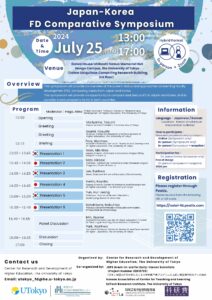
[Event Report] Japan-Korea FD Comparative Symposium

On Thursday July 25th2024, “Japan-Korea FD Comparative Symposium” was held.


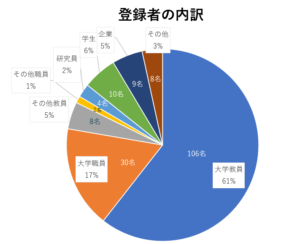
  • ■Number and breakdown of registrants/participants
Registrants:175(including 62 registrants from Korea)
Actual participants: 133 online, 42 in-person (including 8 speakers)
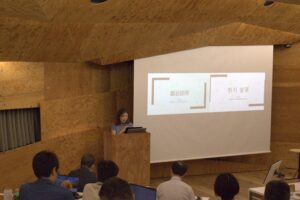
  • ■Outline of the event

First of all, Dr. Takumi Moriyama (Executive Vice President, The University of Tokyo) and Dr. Yasushi Asami (Director of the Center for Research and Development of Higher Education, The University of Tokyo) gave opening remarks. Then, Dr. Wonhwa Park (Assistant Professor, Center for Research and Development of Higher Education, The University of Tokyo) explained the aim of this conference.
In the speakers’ presentations, Dr. Min Woo Nam (Deputy Director of University Innovation Project Office, Daejeon University) gave a presentation on “Adaptive Teaching Support System and Performance Management of CTL in Korean Universities” and Dr. Hiroaki Sato (Professor of Institute for Transdisciplinary Graduate Degree Programs, Osaka University) gave a presentation on “History and Current State of FD in Japan.” They talked about the history and prospects of teacher training systems in Japanese and Korean universities.
Next, Dr. Eunhwa Lee (Dean of the Graduate School of Education, Silla University) gave a presentation entitled “Growth of Korean Association of Center for Teaching and Learning and Issues of the Academic Journal ‘Research on University Teaching and Learning’” and Dr. Kayoko Kurita (Deputy Director of the Center for Research and Development of Higher Education, The University of Tokyo) gave a presentation entitled “Current Status and Future Direction of FD/Pre-FD Initiatives at the University of Tokyo”. They talked about the roles and functions of organizations for implementing and managing CTL and FD in Japan and Korea, respectively.
After a short break, Dr. Hui-Jeong Yun (Professor of Division of General Education, Sookmyung Women’s University) gave a presentation entitled “Current Status and Examples of Learning Support Programs at Korean Universities” and Dr. Nobuhisa Sakakibara (Professorof the Center for the Promotion of Educational Innovation, Shibaura Institute of Technology) gave a presentation entitled “FD Initiatives at Shibaura Institute of Technology: From Individual Faculty Development to Curriculum Integrity Improvement”. They presented examples of practices at various Korean universities and specific situations at Japanese universities.
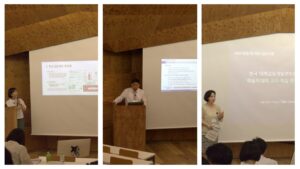
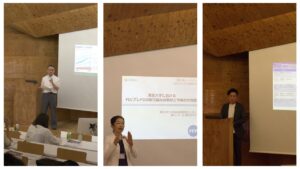
In panel discussion, Dr. Park moderated the discussion and the speakers exchanged their opinions, comparing FD initiatives in Japan and Korea.
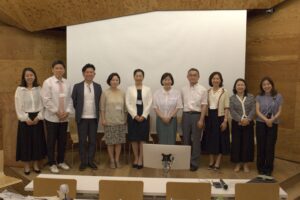
 

  • ■Participant Responses
  • A questionnaire was distributed after this symposium, and a total of 37 people responded. Regarding the level of satisfaction with the event as a whole (on a 5-point scale, 5 = very satisfied and 1 = very dissatisfied), the highest number of respondents, 17 (45.9%), gave the highest rating of 5, and 16 (43.2%) gave the next highest rating of 4.
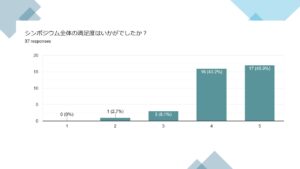
 

Here are some of the feedback we received in the comment section (*Please note that we partly extracted the feedback to anonymize the respondents.):

Good points and opinions on this symposium

“I was able to learn about the current situation and comparison of top FDs in Korea and Japan. All lectures were interesting and informative.”

“It was very interesting to learn about the construction and outcomes of a system to prevent FD from becoming a mere formality.”

“I was able to learn about the points mentioned in the question about the most impressive lecture and that Korea is innovation oriented. Somehow I felt that technology at the acdemic level is quickly applied to the inductries in Korea, but I found out that it derives from higher education.”

“I am glad that you provided interpreters so that we could listen to the lectures in the language we prefer, rather than all in English.”

“Dr. Yun did not talk much about her own institution, Sookmyung Women’s University, but rather gave examples from various Korean universities. This allowed us to see that CTL in Korea is directly linked to the salary structure for university faculty members, and that the disclosure of information is really making it more visible to various stakeholders. In contrast, Dr. Sakakibara introduced actual cases from Shibaura Institute of Technology, where he is affiliated. (…) They spoke in a way that was easy to understand for non-academics.”

“I would venture to say that I felt the theme was something like “Reconsidering University ‘Organizational Power’ and Comparing Japan and Korea,” so I think it would have been nice to hear from both parties involved: university students and faculty members. (…) I think it is worth mentioning that this FD symposium had a good theme and a consistent position of cooperation and thinking between Japan and Korea. The balance was very good.”

“The underdeveloped situation of FD and CTL in Japan became clear, and I felt a sense of crisis.”


All respondents gave high evaluation to various aspects of the symposium, and we are very pleased to hear them. We also received many comments on areas for improvement of this symposium and topics to address in the future. Based on their feedback, we will continue to organize symposiums in the future. We would like to thank all the people who provided valuable comments and suggestions.


■Future Plans

  • We are planning to issue a report on this symposium. As soon as it is completed, we will post an announcement on the UTokyo FD website. We will continue to hold various FD-related events and symposiums in the future, and we sincerely look forward to your participation.
 

Categories
Information

[Event Report] Diversity in the Classroom: A Workshop Exploring Through Case Studies and Activities

[Workshop Overview]
  • Date and Time: Friday, March 15, 2024, 2:00 PM – 4:00 PM
  • Format: In-person (The University of Tokyo, Hongo Campus, Daiwa Ubiquitous Computing Research Building, 2nd Floor Classroom)
  • Instructor: Wonhwa Park (Assistant Professor, Center for Research and Development of Higher Education, The University of Tokyo)
  • Co-Facilitator: Airi Kawakami (Project Academic Specialist, Center for Research and Development of Higher Education, The University of Tokyo)
  • Target Audience: Teachers and graduate students
  • Language: Japanese
  • Fee: Free of charge

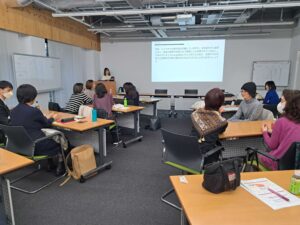
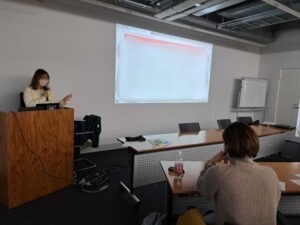
On March 15, 2024, an in-person workshop titled “Diversity in the Classroom: A Worshop Exploring Through Case Studies and Activities” was held.

This workshop was mainly aimed at those who are conducting (or planning to conduct) classes or training sessions related to diversity and multiculturalism, those seeking to create lessons with consideration for diversity, and those interested in developing lessons utilizing active learning.

A total of 16 participants with diverse affiliations and areas of expertise participated in the workshop.


After the workshop, we conducted a post-event survey and received 17 responses (*one duplicate response was received).

To the question “How satisfied were you with the event overall?”, 88% of the participants responded “satisfied” (selecting either the highest rating of “5” or the second highest rating of “4”).

As for the question “Overall, do you think that participating in this event will be useful for you in the future?”, 70% of the participants gave the highest rating of “5” (88% of the total when “5” and “4” were combined).


In addition, we received the following comments in the free description section at the end of the questionnaire.

“∙ The time spent sharing the participants’ questions with the entire group, discussing and sharing ideas was meaningful.
∙ I learned some points of view that I was personally blind to, such as the fact that unconscious bias exists in everyone and that emphasizing diversity may adversely affect minorities.
∙ I learned the effectiveness of the activity at the beginning of the course, in which participants were asked to write “what they expect” and “their current thoughts and opinions” individually, without asking others’ opinions.
∙ I learned that stress (difficulty in participating in learning activities) can be reduced by taking steps such as “think individually, discuss in pairs, and then share with the whole class”.
∙ I was able to reaffirm the importance of creating an environment that is aware of the “3Ks” (especially “with respect.”)”

“I was glad that I learned about “diversity in the classroom” in a very intensive way, both in theory and in practice. In such a short time, I was able to gain a lot of knowledge and skills that I can immediately put into practice in the classroom, such as consideration for students’ names and how to incorporate class activities. That was something that I really wanted to know right now, and I felt really glad that I was able to attend. The overall atmosphere of the workshop was also very friendly, making it easy to share concerns and opinions.”

“I was able to share and discuss my own and other people’s problems. I was able to learn patterns of teaching methods. I gained knowledge about teaching in other fields. I was encouraged by the words, “As long as you have the right direction, you can do it”. The references gave me a chance to learn more.”

“I think it was good that the participants exchanged opinions with each other as well as learned from the experience of the lecturer, Dr. Park, on the various issues involved in diversity. I am satisfied with the valuable learning I gained.”


In the survey, we received many valuable comments on areas for improvement of this event and topics to address in the future events. We will make use of the feedback in our future workshop development.

We received more applications than expected this time, and although the deadline was rescheduled to an earlier date on short notice and the number of participants was expanded, there was still a limit to the acceptable number. We would like to continue to hold workshops in the future so that more people can participate.

For those who were unfortunately unable to attend this year’s workshop, priority will be given to those who attend the next and subsequent workshops.
If you would like to participate in future workshops on similar topics (related to diversity), please click on the link below to register for the information form. We sincerely look forward to your participation.
https://forms.gle/nyQHUFYToKK6w7Gg7