} 学部生 Archives - 東京大学ファカルティ・ディベロップメント | 東大FD | TODAI FD.COM | 東京大学
Categories
Information

[Event Report] UTokyo FD Open: 2025-2026

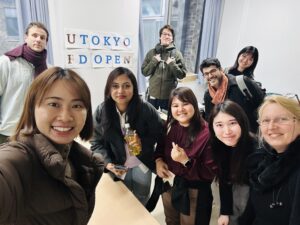
The English-language workshop series “UTokyo FD Open: 2025-2026” was held from October 9, 2025 to February 17, 2026.

Of the nine sessions in total, the first five (October 9, October 23, November 4, November 18, and December 2) were conducted online, while the remaining four (February 12, 13, 16, and 17) were held in person.

A total of 124 participants from 25 countries attended across the nine sessions (including repeat participants), representing a wide range of regions and institutions.
Date Workshop Title Number of Participants Number of Questionnaire Responses(Response Rate) Satisfaction Rate(Average) Overall Evaluation(Average)
October 9 Peer Instruction 22 9 (41%) 7.3 7.6
October 23 Rubrics Design 11 5 (45.5%) 8.4 8.6
November 4 Quality assessment and evaluation 25 14(56%) 8.5 8.5
November 18 Design of questionnaires and multiple-choice questions for evaluation 18 11 (61.1%) 8.6 9
December 2 Flipped classroom 17 5 (29.4%) 8.4 8.4
February 12 Class design and microteaching 8 5 (62.5%) 8 8
February 13 Syllabus review 9 5 (55.6%) 8.6 8.6
February 16 Class design and microteaching 7 6 (85.7%) 8.3 8.3
February 17 Rubrics Design 7 3 (42.9%) 8.3 8.3

The average participation rate for the workshops was 67.2% for the online sessions and 91.6% for the in-person sessions, respectively.

After each workshop, a questionnaire was distributed to participants, who were asked to provide feedback using a 10-point scale (1 = lowest, 10 = highest) as well as through open-ended comments.

Overall, the workshops received very high evaluations, with an average satisfaction rating of 8.3 and an average overall rating of 8.4.
In the open-ended section, we received comments as follows (*Please note that we partly extracted the feedback to anonymize the respondents):

  • ■Participants’ Feedback

“The teacher’s instruction was clear and easy-to-understand, and he worked to create a welcoming atmosphere.”

“The workshop offered clear, practical guidance on how to design effective rubrics, linking theoretical foundations with hands-on examples. The balance between lecture and group discussion was good (…), helping participants share diverse perspectives.”

“Participants brought practical questions, current issues on the table and the teacher helped us to share experiences and opinions along with advice.”

“(The strengths of the workshop were) The mode of delivery, more importantly audience participation. The workshop is highly learner centered.” 

“The workshop is highly organized, ranging from discussion, delivery methodology, and inclusion. The workshop is exceptional and professional.”

“Having group discussion centered around in-class experiences is good, especially to learn from different disciplines.” 

“The mix of participants at different stages in their career was a great experience.” 

“Strengths were that we had to deliver a class, and it was great to see the presentations of others (learned a lot from them not just in terms of learning design but the content itself!!) and it was a great opportunity to test out something myself.”

“Open, interactive environment definitely a strong plus!”

We are very pleased that many respondents provided highly positive evaluations on various aspects of the workshops. We also received numerous comments regarding areas for improvement and topics participants would like to see addressed in the future. Based on this feedback, we will continue to further develop and improve our future events. We would like to express our sincere gratitude to everyone who shared their comments and feedback.


  • ■Future Plans
  • This workshop series was originally held in FY2023 and subsequently paused, and has now been relaunched as UTokyo FD Open: 2025–2026. While we revised several aspects such as the format and completion requirements from the previous edition, the series once again received very positive feedback from a large number of participants.

    Building on the insights gained from this edition and the valuable feedback we received, we will continue striving to further enhance the design and delivery of future events. Details of the next edition will be announced once it is finalized. We sincerely look forward to your participation.


Airi Kawakami(Project Researcher in charge of UTokyo FD Open)
Categories
Information

Publication of “Interactive Teaching: Jissen-hen 3” Now Available on UTokyo BiblioPlaza

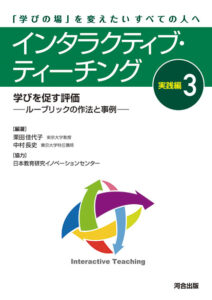
The introduction of the book, “Interactive Teaching: Jissen-hen 3 Manabi o unagasu hyoka [Evaluations to Promote Learning – Rubric Manners and Examples]” (edited by Kayoko Kurita and Nagafumi Nakamura, with the cooperation of Japan Center for Educational Research and Innovation; published by Kawai Publishing) has been published on UTokyo BiblioPlaza, a website that features books authored by faculty members at the University of Tokyo, primarily in the humanities and social sciences.

The concise summary of the book contents is available, so please take a look at the link below.

UTokyo BiblioPlaza – Manabi wo unagasu hyoka

In addition, introductions to other books in the Interactive Teaching series are also available:

Categories
Information

Publication of “Report on the Japan-Korea FD Comparative Symposium”

We are pleased to announce the publication of the report from the “Japan-Korea FD Comparative Symposium,” held on Thursday, July 25, 2024. We hope that the insights shared through the lectures and discussions will contribute meaningfully to faculty development initiatives at institutions in both countries.

Please click here to access the report (in Japanese, PDF).

We hope that this report will be helpful in your FD initiatives.

Categories
Information

[Event Report] Japan-Korea FD Comparative Symposium

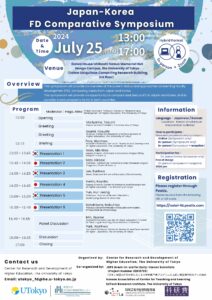
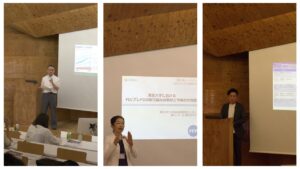
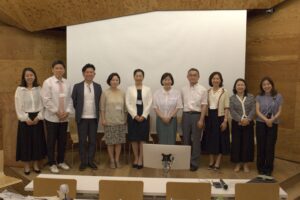
On Thursday July 25th2024, “Japan-Korea FD Comparative Symposium” was held.


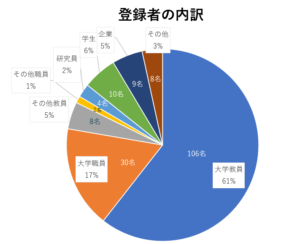
  • ■Number and breakdown of registrants/participants
Registrants:175(including 62 registrants from Korea)
Actual participants: 133 online, 42 in-person (including 8 speakers)

  • ■Outline of the event

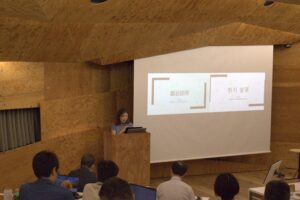
First of all, Dr. Takumi Moriyama (Executive Vice President, The University of Tokyo) and Dr. Yasushi Asami (Director of the Center for Research and Development of Higher Education, The University of Tokyo) gave opening remarks. Then, Dr. Wonhwa Park (Assistant Professor, Center for Research and Development of Higher Education, The University of Tokyo) explained the aim of this conference.

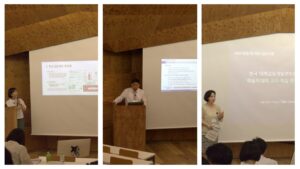
In the speakers’ presentations, Dr. Min Woo Nam (Deputy Director of University Innovation Project Office, Daejeon University) gave a presentation on “Adaptive Teaching Support System and Performance Management of CTL in Korean Universities” and Dr. Hiroaki Sato (Professor of Institute for Transdisciplinary Graduate Degree Programs, Osaka University) gave a presentation on “History and Current State of FD in Japan.” They talked about the history and prospects of teacher training systems in Japanese and Korean universities.
Next, Dr. Eunhwa Lee (Dean of the Graduate School of Education, Silla University) gave a presentation entitled “Growth of Korean Association of Center for Teaching and Learning and Issues of the Academic Journal ‘Research on University Teaching and Learning’” and Dr. Kayoko Kurita (Deputy Director of the Center for Research and Development of Higher Education, The University of Tokyo) gave a presentation entitled “Current Status and Future Direction of FD/Pre-FD Initiatives at the University of Tokyo”. They talked about the roles and functions of organizations for implementing and managing CTL and FD in Japan and Korea, respectively.
After a short break, Dr. Hui-Jeong Yun (Professor of Division of General Education, Sookmyung Women’s University) gave a presentation entitled “Current Status and Examples of Learning Support Programs at Korean Universities” and Dr. Nobuhisa Sakakibara (Professorof the Center for the Promotion of Educational Innovation, Shibaura Institute of Technology) gave a presentation entitled “FD Initiatives at Shibaura Institute of Technology: From Individual Faculty Development to Curriculum Integrity Improvement”. They presented examples of practices at various Korean universities and specific situations at Japanese universities.

In panel discussion, Dr. Park moderated the discussion and the speakers exchanged their opinions, comparing FD initiatives in Japan and Korea.


  • ■Participant Responses
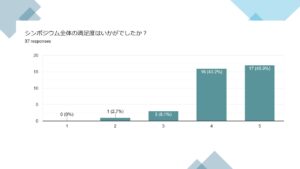
  • A questionnaire was distributed after this symposium, and a total of 37 people responded. Regarding the level of satisfaction with the event as a whole (on a 5-point scale, 5 = very satisfied and 1 = very dissatisfied), the highest number of respondents, 17 (45.9%), gave the highest rating of 5, and 16 (43.2%) gave the next highest rating of 4.


Here are some of the feedback we received in the comment section (*Please note that we partly extracted the feedback to anonymize the respondents.):

Good points and opinions on this symposium

“I was able to learn about the current situation and comparison of top FDs in Korea and Japan. All lectures were interesting and informative.”

“It was very interesting to learn about the construction and outcomes of a system to prevent FD from becoming a mere formality.”

“I was able to learn about the points mentioned in the question about the most impressive lecture and that Korea is innovation oriented. Somehow I felt that technology at the acdemic level is quickly applied to the inductries in Korea, but I found out that it derives from higher education.”

“I am glad that you provided interpreters so that we could listen to the lectures in the language we prefer, rather than all in English.”

“Dr. Yun did not talk much about her own institution, Sookmyung Women’s University, but rather gave examples from various Korean universities. This allowed us to see that CTL in Korea is directly linked to the salary structure for university faculty members, and that the disclosure of information is really making it more visible to various stakeholders. In contrast, Dr. Sakakibara introduced actual cases from Shibaura Institute of Technology, where he is affiliated. (…) They spoke in a way that was easy to understand for non-academics.”

“I would venture to say that I felt the theme was something like “Reconsidering University ‘Organizational Power’ and Comparing Japan and Korea,” so I think it would have been nice to hear from both parties involved: university students and faculty members. (…) I think it is worth mentioning that this FD symposium had a good theme and a consistent position of cooperation and thinking between Japan and Korea. The balance was very good.”

“The underdeveloped situation of FD and CTL in Japan became clear, and I felt a sense of crisis.”


All respondents gave high evaluation to various aspects of the symposium, and we are very pleased to hear them. We also received many comments on areas for improvement of this symposium and topics to address in the future. Based on their feedback, we will continue to organize symposiums in the future. We would like to thank all the people who provided valuable comments and suggestions.


■Future Plans

  • We are planning to issue a report on this symposium. As soon as it is completed, we will post an announcement on the UTokyo FD website. We will continue to hold various FD-related events and symposiums in the future, and we sincerely look forward to your participation.


Categories
Information

[Report] Coursera “Interactive Teaching”: The 3rd Real Session DAY 3

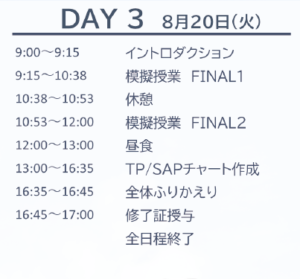
The following is a brief summary of DAY 3 of the Real Session held on August 20th (Tue), 2024.

  • ■Objectives for DAY 3
  • ●Be able to apply what you learned when conducting a lecture for microteaching sessions.
  • ●Be able to envision your career path and organize your daily activities and future prospects.


■DAY 3 Schedule

  • [Microteaching Session: Final] (9:15–12:00)
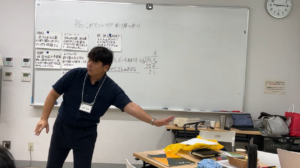
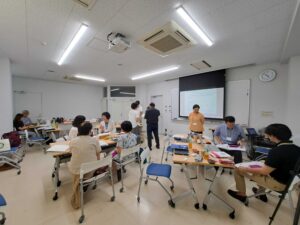
  • Participants conducted refined lectures for the microteaching session. They delivered lectures one by one, just like the first trial on DAY 1, but this time the lectures were given to the whole participants instead of groups.
  • STEP 1: A participant conducts a lecture as a lecturer. (6 min)
  • STEP 2: The lecturer-participant receives feedback from the instructors while the other participants fill in the feedback sheets.
  • STEP 3: Whole participants exchange feedback.
A participant giving a lecture (2nd trial)


  • [TP/SAP Chart Creation] (13:00–16:35)
  • Participants were divided into two groups according to their needs and respectively created a chart: a TP chart (Instructo: Kurita) or a SAP chart (Instructor: Park). The objectives of this activity were to reflect on their teaching/research activities and to make use of such reflection in improving their future classes and clarifying their career paths.
Participants creating SAP charts
Participants sharing their SAP charts


  • [Reflection on the Entire Session] (16:35–16:45)
  • Participants reflected on the entire session and individually organized what they had learned and their thoughts.


  • [Award of Certificate of Completion] (16:45–17:00)
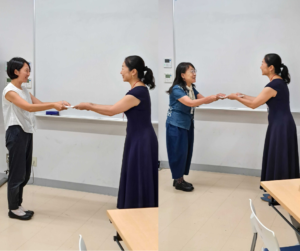
  • The certificates of completion were awarded to participants.
Award of certificate of completion


  • ■Participants’ Reactions
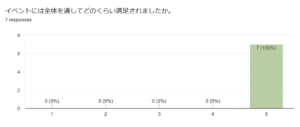
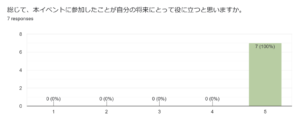
  • Seven participants answered our questionnaire after the session. Regarding the question on the satisfaction of the whole event (i.e., a five-point scale question with “5: Extremely satisfied” and “1: Extremely dissatisfied”), all the respondents (100%) rated “5” (the highest). Furthermore, again all the respondents (100%) rated “5” (the highest) to the question asking whether participation in the event would be useful to their future (“5: Strongly agree” and “1: Strongly disagree”).


Here are some of the feedback we received in the comment section (*Please note that we partly extracted the feedback to anonymize the respondents.):


What did you find good about this event?

“The limitation of the setting of the microteaching class to be a 6-minute class, rather than a 6-minute cutout of a longer class, and that the microteaching class was conducted twice. Also, the program structure allowed us to learn knowledge during the two sessions, which we could immediately apply to improve the microteaching classes. In addition, the instructors were friendly and paid close attention to detail, and everyone who participated enjoyed the great atmosphere. Thank you very much for your help.”

“That I was able to experience interactivity as a value in real classes after taking online courses. That I was able to learn with peers who have the same ambitions. That I was able to reflect on myself based on the 3Ks.”

“That I was able to deepen our understanding of class design, syllabus, rubrics, etc. by hearing directly from Dr. Kurita and interacting with my peers.”

Other remarks and comments

“I am grateful for finding Interactive Teaching. To Dr. Kurita and everyone, I wish you all the best in your endeavors. And please bless us again with your achievements. I, too, will do my best with the words, “We can learn from our mistakes” (I was saved by these words!) in mind.” 

“I am super grateful to Dr. Kurita, the staff, my peers, the learning environment, and my lunch boxes.”

“I think it is worth the three days of time. I hope you will continue to do so. And I hope that I will help to improve education through my learning here. Thank you very much.”

“Thank you very much for this workshop! I had a precious opportunity to learn about class design and curriculum design while practicing, and it was an intense three days in which I thought about a great many things. I would like to make use of the many things I learned from Dr. Kurita in my future classes. I learned a lot from the 6-minute class. Thank you to all the staff members!”

We are pleased that we received high ratings from all the respondents in various aspects. They also provided us with a lot of comments on the points that need improvement and requests for topics to be focused on in the future. We are eager to develop new events based on the opinions we received. We would like to express our sincere gratitude to all the people who provided us with feedback.


  • ■What’s Next?
  • It was the third time to hold the Real Session as an event of Coursera “Interactive Teaching.” The responses to our questionnaire show that many of the participants learned a lot from the Real Session. Although there were some inconveniences, we were able to successfully complete the event thanks to the understanding and cooperation of all those who attended. We are eager to develop/run events based on the feedback. We are going to organize various education-/FD-events, so we hope that many people will join our future events. Details are to be announced. We look forward to your participation.


  • Click here for the details of DAY 1.
  • Click here for the details of DAY 2.


Airi Kawakami (Project Academic Specialist in charge of “Interactive Teaching”)

Categories
Information

[Report] Coursera “Interactive Teaching”: The 3rd Real Session DAY 2

The following is a brief summary of DAY 2 of the Real Session held on August 19th (Mon), 2024.

■Objectives for DAY 2

  • ●Experience active learning strategies and be able to use them.
  • ●Be able to describe a course that lets students learn actively in the form of a syllabus.
  • ●Be able to design an evaluation based on essential knowledge.
  • ●Be able to apply what you learned when conducting a lecture for microteaching sessions.


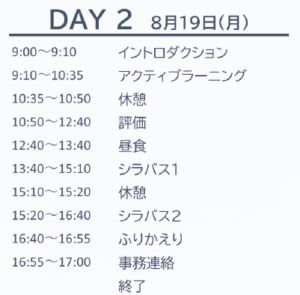
■DAY 2 Schedule

■Summary

  • [Active Learning] (9:10–10:35)
  • The instructor gave a lecture on active learning. Participants experienced one of the active learning strategies, “Peer Instruction.”
Peer instruction


  • [Evaluation] (10:50–12:40)
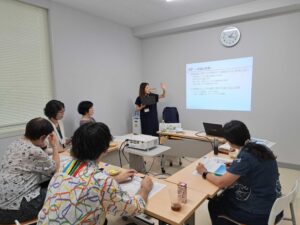
  • The lecture on rubrics was followed by a group activity on creating rubrics with a large paper and sticky notes. After that, participants viewed rubrics made by other groups in a poster tour format.
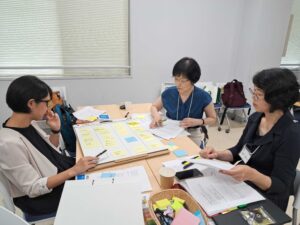
Participants creating a rubric
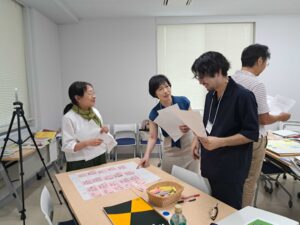
Poster tour
  • [Syllabus] (13:40–16:40)
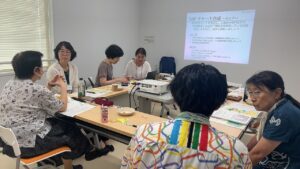
  • Participants listened to a lecture on syllabuses and worked on an activity. They created graphic syllabuses and shared them in groups. They also revised their text syllabuses by referring to the tips on creating them.
Participants creating graphic syllabuses


  • [Reflection] (16:40–16:55)
  • Participants reflected on the goals and objectives of DAY 2 and individually organized what they had learned and their thoughts.


DAY 2 became another busy day where participants not just listened to lectures but also experienced active learning strategies and worked on various activities. It was designed to let them apply what they learned to the revision of their lectures and syllabuses.

  • Click here for the details of DAY 3.
  • (Click here for the details of DAY 1.)


Airi Kawakami (Project Academic Specialist in charge of “Interactive Teaching”)

Categories
Information

[Report] Coursera “Interactive Teaching”: The 3rd Real Session DAY 1

  • 【Overview of the Coursera “Interactive Teaching”: The 3rd Real Session]
  • Date/Time: August 18th (Sun), 2024, 9:00–17:00, 19th (Mon), 9:00–17:00, and 20th (Tue), 9:00–17:00
  • Format: Face-to-face
  • Venue: Faculty of Education Bldg., Hongo Campus, The University of Tokyo
  • Instructors: Kayoko Kurita and Wonhwa Park, Airi Kawakami, Osami Nabeta (The University of Tokyo)
  • Intended for: Those who completed “Interactive Teaching” and are able to work on pre-assignments
  • Language: Japanese
  • Fee: Free of charge

“Coursera ‘Interactive Teaching’: The 3rd Real Session” was held as a face-to-face event on August 18th, 19th, and 20th. The Real Session was intended for those who had completed the course “Interactive Teaching,” and 10 people with various occupations and affiliations gathered from across the country.

The following is a brief summary of DAY 1.


■Objectives of the Real Session

  • 1. Be able to devise methods that help you induce/maintain/enhance students’ motivation.
  • 2. Be able to design a class that lets students learn actively.
  • 3. Experience active learning strategies and be able to use them.
  • 4. Be able to describe a course that lets students learn actively in the form of a syllabus.
  • 5. Be able to design an evaluation based on essential knowledge.
  • 6. Be able to apply what you learned when conducting a lecture for microteaching sessions.
  • 7. Be able to envision your career path and organize your daily activities and future prospects.

The objectives for DAY 1 were 1, 2, and 6 in the above list.


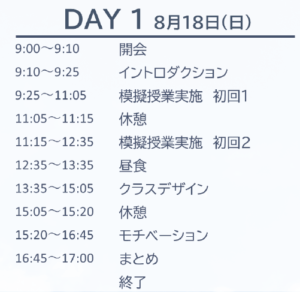
■DAY 1 Schedule


■Summary

  • Preparation
  • Participants worked on pre-assignments and prepared the following materials for the session: (1) a 6-min lecture for microteaching sessions, (2) class design, and (3) a text syllabus. Also, they posted a self-introduction in Google Classroom.


  • DAY 1 (August 18th, 2024)
  • [Introduction] (9:00–9:25)
  • The session started at 9:00 by sharing goals and objectives, followed by a brief self-introduction of the instructors, staff, and participants.


  • [Microteaching Session: The 1st Trial] (9:25–12:35)
  • Each participant conducted a lecture for microteaching sessions in two groups. They were reminded of the basic principles (such as “3Ks”) and how to take part in role-playing before delivering a lecture one by one, just like the regular UTokyo FFP classes as described as follows:
  • STEP 1: A participant conducts a lecture as a lecturer. (6 min)
  • STEP 2: The lecturer-participant receives feedback from the instructor while the other participants fill in the feedback sheets.
  • STEP 3: Participants exchange feedback in a group to improve the lecture.
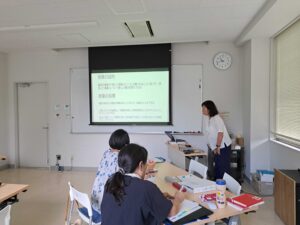
A participant conducting a lecture for the microteaching session


  • [Class Design] (13:30–15:00)
  • The instructor gave a lecture on class design. Participants worked on an activity to revise their lectures, reviewing the rubric for class design.
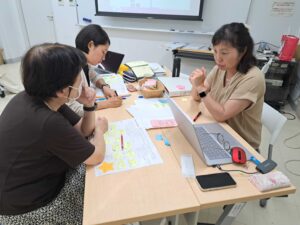
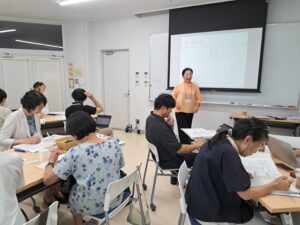
Participants revising their own class design


  • [Break] (15:00–15:15)
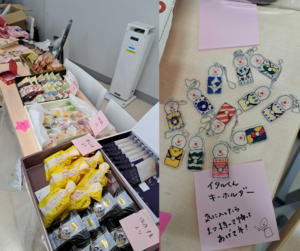
  • We asked participants beforehand if they could bring their local snacks. Thanks to all the participants, the snack area was filled with a variety of sweets. We offered hot/iced coffee, too. As a giveaway, we crafted key chains of the course mascot character “Ital-kun” so that the participants could feel free to take them home.
Snack area


  • [Motivation] (15:20–16:45)
  • The instructor gave a lecture on motivation. In the activity “Let’s give advice to a professor,” participants discussed in groups what kind of advice they should give to an instructor about his/her concern. Also, they worked on revising their lectures by applying what they had learned in the session in the activity “Refining lectures for microteaching sessions.”
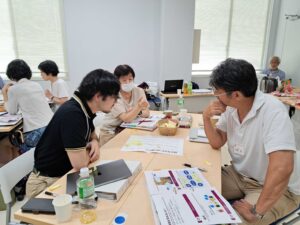
Group activity on motivation


  • [Wrap-up] (16:45–17:00)
  • Participants reflected on the goals and objectives of DAY 1 and individually organized what they had learned and their thoughts. Then, they shared their thoughts in pairs.
Participants sharing their thoughts in pairs


Participants had a busy schedule on DAY 1, starting with a microteaching session in the morning and lectures and activities in the afternoon, but they all stayed focused and eagerly worked on every task.

  • Click here for the details of DAY 2.
  • (Click here for the details of DAY 3.)


Airi Kawakami (Project Academic Specialist in charge of “Interactive Teaching”)

Categories
Information

Launch of a New Course on Coursera “Learn How to Teach by 6 Min. Micro Teaching”

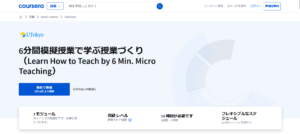
A new course “Learn How to Teach by 6 Min. Micro Teaching” was released on Coursera on August 27th, 2024.

This course is a program to learn specifically how to design and improve classes through the creation of a 6-minute microteaching class. The course is designed for current and aspiring teachers from elementary education to higher education, and can be completed in three weeks. The program aims to help learners understand the significance of the “6-minute microteaching class,” and learners practice the necessary knowledge and theories based on the “ADDIE Model,” a key framework for creating classes, through a variety of work (hands-on experience). Then, by creating a graphic class design and a class design sheet, learners design and conduct a microteaching class. Afterwards, learners will review the microteaching class and work on improvement. In addition to watching videos and completing worksheets (individual work), the course also emphasizes the expansion and deepening of learning through interaction with other learners in the community platform such as discussion forums.

All course content is available free of charge. A certificate of completion can also be issued for a fee.
In addition to learning materials in Japanese, English-language materials (subtitles, worksheets and lecture slides) are also available. On top of that, you can learn at your own pace. We hope you enjoy our program!

Click here to enroll in the course.

6分間模擬授業で学ぶ授業づくり(Learn How to Teach by 6 Min. Micro Teaching) | Coursera


■Related program
Interactive Teaching(インタラクティブ・ティーチング) | Coursera

Categories
Event

[Aug 18, 19, 20] “Interactive Teaching” Real Session

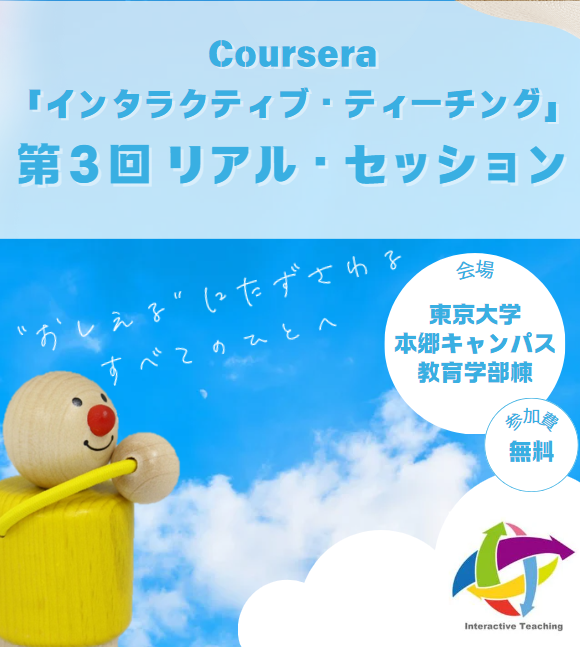
We are very pleased to announce that we will hold an intensive 3-day in-person session, Interactive Teaching Real Session. In this session, participants will not only deepen the knowledge they have learned in Interactive Teaching but also learn practically through many works such as conducting a microteaching class, designing a syllabus, and creating a TP/SAP chart. 

If you would like to join this event, please fill out the form below (Japanese):

https://forms.gle/gGGeLEBV5o32p9Z26

The information of the event is as follows:

【The outline of Interactive Teaching Real Session】

  • Date and time: August 18th (Sun) 9:00-17:00, 19th (Mon) 9:00-17:00, 20th (Tue) 9:00-17:00 (JST) (+ optional social gathering). Note: please participate all three days.
  • Format: In-person (Faculty of Education Building, Hongo Campus, The University of Tokyo)
  • Instructors: Kayoko Kurita, Wonhwa Park, Airi Kawakami, Osami, Nabeta (the University of Tokyo)
  • Targeted attendees: Those who have completed (or are expected to complete by August 11th, 2024) Interactive Teaching and are able to work on the pre-assignments.
  • Language: Japanese
  • Fee: Free 
  • Capacity: 16 people

*The selection will be conducted based on the “Motive for Participation” and “Class Design Sheet” submitted through the application form. Results will be notified once your application is reviewed. 

  • Registration deadline: Monday, 5 August 2024 9:00 AM (JST)
  • Content: The goal of this session is to acquire practical knowledge and experience applicable to your own classes, through various exercises based on the learning in “Interactive Teaching”. Prior to the session, we would like participants to complete the pre-assignments: preparation of (1) micro-teaching, (2) class design, and (3) text syllabus. (In terms of the class design and text syllabus, those who are not currently teaching will be asked to prepare them, assuming classes they are likely to be in charge of.) Details will be announced at a later date. For the schedule of the session, please click here


*For this event, we will conduct a satisfaction survey to understand participants’ opinions, to analyze the learning effects for research purposes and to utilize the results for the improvement of our future events. If the survey is to be published as research, it will be statistically processed and made public in consideration of anonymity. We kindly ask for your cooperation. 

*To participate in this session, you are required to complete the course “Interactive Teaching” by August 11th. If you would like to take the Coursera course, please read the following and enroll (for free).


We sincerely look forward to your participation!

====================================

[“Interactive Teaching” Course Description]

・How to take the course: Please sign up on Coursera, and you can take the course from the following URL. Interactive Teaching | Coursera

・Language of instruction: Japanese (English worksheets and subtitles available) 

・Lecturers: Dr. Kayoko Kurita (The University of Tokyo) and others

・Fee: Free (An additional fee is necessary for a certificate. )

・Content: The course has eight WEEKs, each comprising three sessions: Knowledge, Skill, and Story. Please refer to Interactive Teaching | Coursera for more details.

[Inquiries]

Airi Kawakami (Center for Research and Development of Higher Education, The University of Tokyo)

E-mail: utokyo_fd@he.u-tokyo.ac.jp