} 学部生 Archives - Page 3 of 15 - 東京大学ファカルティ・ディベロップメント | 東大FD | TODAI FD.COM | 東京大学
Categories
未分類

An Example of the Jigsaw Method

“Let’s learn about prenatal diagnosis and its different types.”


This is an example of a senior high school class combined with biology, health and physical education, and home economics. Expert groups of four first do research on one of the multiple types of “prenatal diagnosis.”

Then, form jigsaw groups comprising each member from different expert groups and let them compare and examine the multiple types of “prenatal diagnosis.” And let them organize the differences, purpose, and advantages/disadvantages of each type.

Let the students return to their original group (i.e., expert group), organize what they discussed in jigsaw groups, and compose reports.

This example is more complicated than the one shown in the “Implementation” section, which is called “Knowledge Constructive Jigsaw.” It also comprises the method of “poster tour.”
Students can learn about the multiple types of “prenatal diagnosis” and their differences and deepen their understanding of how “prenatal diagnosis” is conducted in real clinical settings.

Categories
未分類

An Example of Think-Pair-Share

“What did you learn in the last class?”


For a yearlong course, start the first several classes with this question until you get the pace of your classes.
It is a tool to clarify the emphasis on student output in your classes. You can also expect the following effects:


・It helps your students get along with each other by using it in the early stage of the course.

・It helps your students make it a habit to relate what they learned in the last class to what they will learn today.

・It helps your students clarify their memory and consciousness by outputting. It enables them to recall what they learned in the last class and relate it to what they will learn today.

・It helps your students realize the importance of how others learn by experiencing the difference in perspectives and expressions with other learners even if they are taking part in the same class.

Categories
Event

[Sep 17, 18, 19] Coursera “Interactive Teaching” 1st Live Session

Center for Research and Development of Higher Education, The University of Tokyo is pleased to invite you to our intensive 3-day in-person session for the course “Interactive Teaching” to be held on September 17th, 18th and 19th.

The goal of this session is to acquire practical knowledge and experience applicable to your own classes, through various exercises based on the learning in “Interactive Teaching”.

For more details, please click the following link.

[Sep 17, 18, 19] Coursera “Interactive Teaching” 1st Live Session – Center for Research and Development of Higher Education, The University of Tokyo

Categories
Information

[New Paper] Prof. Kayoko Kurita (Vice Director, Center for Research and Development of Higher Education, The University of Tokyo) et al.

Prof. Kayoko Kurita (Vice Director, Center for Research and Development of Higher Education, The University of Tokyo) et al. have published a new research paper entitled, “Kyōiku katsudō no furikaeri o mokuteki to shita teaching portfolio chart oyobi sakusei kenshū no kaihatsu to hyōka [Development and evaluation of a teaching portfolio chart and a workshop in its creation for the purpose of reflection on teaching activities].” It is available online at J-STAGE.

For details, please click the following link. [New Paper] Prof. Kayoko Kurita (Vice Director, Center for Research and Development of Higher Education, The University of Tokyo) et al. – Center for Research and Development of Higher Education, The University of Tokyo (u-tokyo.ac.jp)

Categories
Event

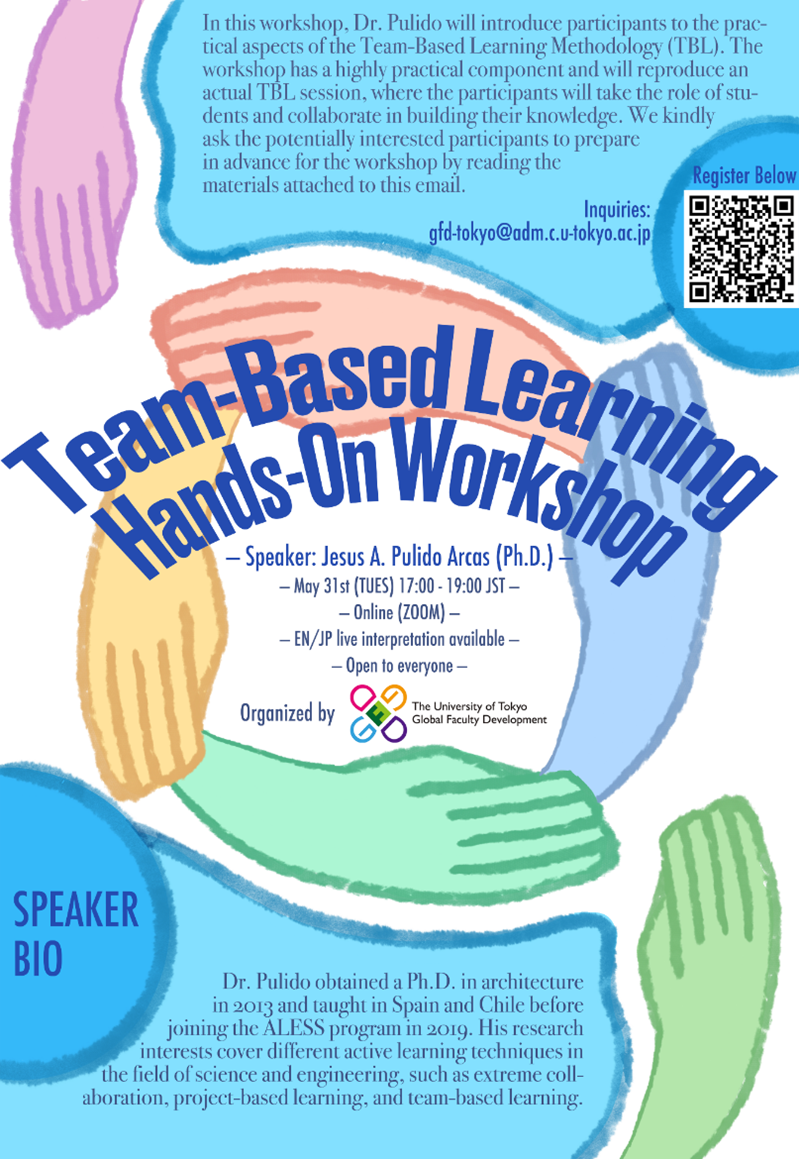
Introduction of “Global FD Workshop” held on May 31

The Global Faculty Development (GFD) Program would like to invite you to our workshop which will be held on Tuesday, May 31.

The theme is ” Team-Based Learning Hands-on Workshop ” and the guest speaker is Jesus Pulido Arcas (P.h.D).

Please read the datails as followsre listed below: → Introduction of “Global FD Workshop” held on May 31

Categories
Information

“UTokyo Research Support” Website Now Open (*Login Required / Limited to UTokyo Members)

We are pleased to introduce the launch of the “UTokyo Research Support” website, which aggregates and provides information on the various internal and external support programs for researchers for UTokyo graduate students and researchers.
The programs posted on the website include not only those for early-career researchers and graduate students but also those for researchers with mid-level or longer careers. Its new pamphlet is downloadable for anyone regardless of their affiliation with the University. Details are as follows:

1. UTokyo Research Support
https://www.u-tokyo.ac.jp/adm/researchersupport/en/index.html
[Note] Login with ID/PW limited to UTokyo members is required. Please refer to the information posted on the UTokyo Portal website.* (Access is limited to UTokyo members.)

2. Researcher Support Program Pamphlet 2022
The pamphlet is available for anyone regardless of their affiliation with the University. It can be downloaded from the UTokyo website.
https://www.u-tokyo.ac.jp/ja/research/systems-data/support.html

3. Features of the website and pamphlet
○ Support programs for researchers provided by the University of Tokyo and government agencies are organized in a list.
○ In addition to the support programs for early-career researchers and graduate students, the website offers programs for researchers with mid-level or longer careers. It categorizes the programs into these three stages of researchers and seven items based on purpose.
○ The description of each program includes information such as “Summary,” “Target,” “Support Details,” “Application Period,” and “Features.”
○ The website provides information in both Japanese and English and is thus open to researchers from overseas, too.

*UTokyo Portal website: “UTokyo Research Support” and “Researcher Support Program Pamphlet 2022”


Categories
Information

Welcome to the New UTokyo FD Website

Thank you for visiting the website of UTokyo Faculty Development (UTokyo FD).
Center for Research and Development of Higher Education, The University of Tokyo is pleased to announce the launch of our new website.

Based on the slogan “Let’s learn to teach at university,” we integrated the previous search items into a single one (“Search by Purpose”) and redesigned the whole structure with the UTokyo FD logo and photos/colors relaxing for the eyes.


(The front page)


*Features of the new website:

・Design that allows the visitors to view and search items easily
・Colors and design that fit faculty/students/researchers
・Responsive web design for smartphone/PC users
・A website dedicated to faculty development (FD), where instructors inside and outside the University can interact with each other
・Combination of static pages on program introduction and dynamic pages on articles such as the “Teaching Tips” series.


(Menu)


“Teaching Tips” and English pages will be published soon. Please stay tuned for further updates!

Categories
Event

Introduction of “Global FD Event” held on March 23rd

The Global Faculty Development (GFD) Program would like to invite you to the presentation which will be held on Wednesday, March 23rd.

The theme is “Interdisciplinary Roundtable on Diversity, Equity, and Inclusion in the Academy” and this event is the culmination of the GFD Program Series on “Diversity in Higher Education”.

Facilitator will be Mr. Mark R. Bookman Ph.D, who is the Postdoctoral Fellow at Tokyo College.  Tokyo College (u-tokyo.ac.jp)

Please read the datails as follows Introduction of “Global FD Event” held on March 23rd


Categories
未分類

1: Think-Pair-Share

Think-Pair-Share


1. Definition

“Think individually (THINK), then pair up (PAIR), and discuss and share ideas (SHARE).”

Think-Pair-Share is an active learning strategy conducted through the discussion procedure as described above.
It was first proposed by Frank Lyman at the University of Maryland in 1981.


2. Implementation

❶ Ask a question to your students.
❷ Give them one or two minutes to individually think about the question.
❸ Pair up the students.
❹ Let the students exchange and share their ideas in pairs.
(This step can be substituted by activities among multiple pairs at once or activities among groups of three or more.)
❺ Let each pair share their ideas with the whole class. (One person per pair/group shall be the speaker.)
❻ It takes 5–15 minutes in total. (It depends on the number of participants.)

(The image of students working in pairs)


3. Features and Tips

・It can also be used in large classes.
・It works as a practice in communicating with others.
・It can be used for various activities including warm-ups.
・It may end up chatting depending on the question or group size.
→It is necessary to set specific questions, give instructions with clarity, and be considerate of your students’ level. Avoid posing simple questions that depend on whether the students have certain knowledge or not, such as questions that ask about a specific year or name!

4. Examples

Click the following link. → An example of “Think-Pair-Share”

5. References and Other Materials

Click the following link. →  Video clips related to Think-Pair-Share